Investigations by Priyanka Bansal, Sarah Doherty, Alexander Lewis, Xiaoyu Li, and Margaret Shepherd
healthcare workers face unprecedented extremes
.png)
Instructions for PPE equipment reuse are placed alongside boxes of gloves in many New Jersey hospitals. Photo: Mitsu Yasukawa/ Northjersey.com
With cases across New Jersey skyrocketing, doctors and nurses from every profession in the medical field are finding themselves being called to work in COVID units. At the Salem Medical Center, it’s no different. Volunteers, retired healthcare workers, and active doctors and nurses are finding themselves working hours on end, fighting to keep Salem County’s
134 coronavirus patients from dying, a battle they’ve lost 6 times already.
“A hundred-some cases doesn’t seem like much, but you know it’s getting out of hand when they’re moving a geryatric nurse to a COVID unit,” says one of Salem Medical Center’s nurses who wished to remain unnamed. So far, he’s worked at least 14-hours every day for the past week in the center’s new COVID-19 unit, something he says he never expected to have to do.
Salem Medical Center has a bed capacity of only 126, many of which are constantly occupied by other patients. With the amount of cases that Salem County has now, the low number of hospital beds available for patients with coronavirus who need to be hospitalized is not a problem. However, the former geryatric nurse says that unless residents take the proper precautions, the hospitals could soon be in trouble: “People have to actually listen to the governor when he tells you to stay inside. We don’t have enough hospital beds, let alone ventilators, in all of Salem County for the amount of cases we could see.”
Recently, the Salem County nurse was tested for COVID himself after feeling achy, short of breath, and having a slight cough. Being around the patients with con made him a prime candidate for the virus, the test was administered to him at the hospital where he works. Fortunately the test came back negative, the nurse saying that his symptoms were probably due to exhaustion caused by the extra hours he’s been forced to put in. “We’re all on our feet for 14-hours straight every day,” he said, “We hardly get any breaks because that would require us taking off our PPE (personal protective equipment), and that’s such a hassle anymore now that we’re low on supplies.”
The lack of personal protective equipment in hospitals is not exclusive to hospitals in Salem County. Across the state, healthcare workers have seen a mass shortage in protective masks, gloves, and face shields, all of which are absolutely essential when working in a COVID-19 unit. Staff at hospitals across the state are being forced to reuse masks, many of which are not even the proper N-95 respirator masks, long past their capacity. “I go in and I have to wear the same mask every day for five to seven days,” the nurse says, “There’s a whole process to taking it off too. The masks all go in individual plastic zip-lock bags at the end of the day, and then the next shift the same ones go right back on.
The nurse said that he gets relief from helping out patients, but the imminent threat of someone dying or passing the virus on to hospital staff is always intimidating. Knowing he’s making a difference, however, definitely has him holding his head up as he walks into his extended shift. He says that there’s only really one thing that gets him through some of the tougher shifts, “The feeling of taking your mask off at the end of the day and just breathing… It’s got to be the best feeling in the world.”
facing the unknown
The coronavirus pandemic is the most difficult test most healthcare workers have ever had to face. Nurses all over the state struggle with feelings of uneasiness and uncertainty.
Sarah Duffner, a Registered Nurse (RN) in Atlantic County at the Atlanticare Regional Medical Center says “There’s a lot of stress...because we don’t know what’s going on in any given moment.” One moment she may be dealing with someone who is thought to have pneumonia, only to find out a couple days later that it had actually been the coronavirus.
While Duffner is not stationed in the designated coronavirus units, she says units that are holding coronavirus patients are beginning to overflow -- and her floor is in line to absorb it.
Increased safety measures have been put in place to prepare for the surplus of coronavirus patients. All nurses must be wearing their face mask, face-barrier, and hair bonnets at all times.
Still, Duffer finds that her hospital faces a shortage of essential PPE. Her hospital does not have a substantial supply of N95 masks -- which are more tight-fitting than other masks and can filter out approximately 95 percent of viruses and bacteria.
All workers, aside from those on designated coronavirus floors, are wearing regular surgical masks instead. Surgical masks do not have the capability to filter out germs like N95s, due to how they fit more loosely around the face and the material they are made from.
In usual circumstances, N95s would be available, and nurses would wear those instead of surgical masks. The N95s would also be single-use.
Yet, in the hospital’s effort to conserve its supplies, all surgical masks are worn for a week or longer before they are thrown away. Gowns are also particularly hard to come by.
And smaller areas are not immune. Other hospitals in shore communities are also experiencing a shortage of supplies and an influx of cases. At Cape May County’s only hospital, which has less than 300 beds, a nurse, who asked to not be identified, says that each time she returns for another shift, there are more patients being ruled out for the coronavirus. Covid-19 patients and those suspected to test positive must be put into specific rooms to prevent spread of the virus, called negative air pressure rooms, of which her hospital only has seven.
Negative air pressure rooms prevent any air from leaving the room -- all air is pulled inward through a filtration system -- which lowers the risk of transmitting the virus to other hospital patients as well as healthcare workers. These rooms are particularly important to have in Covid-19 units as the virus can be aerosolized -- made airborne -- when infected patients are intubated or given chest compressions.
Many nurses felt blindsided at how fast the coronavirus pandemic hit sparsely populated Cape May County. But the Cape Regional nurse suspects that coronavirus has been hiding in the area for far longer than anyone suspects. Back in November, many patients were coming in extremely ill, but testing negative for the flu while presenting with lung symptoms, leaving many healthcare professionals in the county now presuming that those patients had coronavirus.
.png)
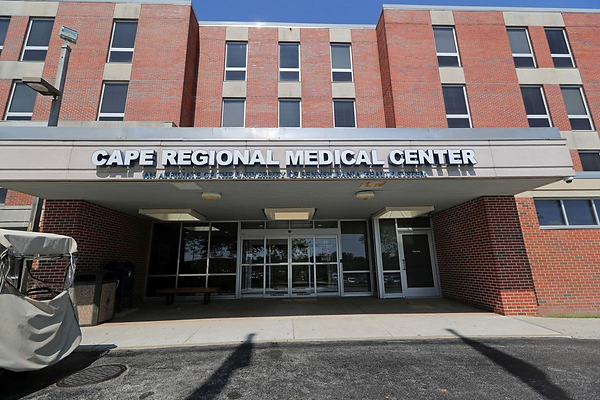
Cape Regional Medical Center, Cape May County’s only hospital, photographed by Craig Mattews of the Press of Atlantic City on August 22, 2019
Still, keeping up with the influx of confirmed Covid-19 cases lately has been demanding both physically and mentally for healthcare workers. “It’s exhausting. You’re exhausted. Everybody’s a little more stressed because you don’t know what to expect,” said the Cape May County nurse. While the number of patients testing positive is growing, the amount of those coming in for conditions unrelated to the virus has
drastically decreased. Residents are being overly cautious due to fear of catching the virus, and many nurses are worried that people --especially the vulnerable and elderyly populations -- are not getting the medical care they need.
However, many do not realize that nurses are scared too. “This is real and it’s here in Cape May County, in what I thought was our safe little bubble,” says the Cape Regional nurse.
She cannot even feel a sense of relief after leaving work and returning home. She does not enter the house in her uniform. She leaves her shoes outside the front door. As soon as she enters her home she showers and then disinfects every surface she touched. She also distances herself from her own family in an effort to protect them from coming down with the virus.
“Even though I’m home with my kids, I feel like I’m not,” said the Cape May County nurse. She has not hugged or kissed her children for weeks. After a long day of working in a stressful environment, many nurses cannot fall into the embrace of their own family, leaving them feeling isolated and more distressed than ever before.
north jersey faces a similar fate
One nurse in Union County, who asked to remain anonymous, says he moved out of his own home, along with his mother who is also a healthcare worker, in order to protect the rest of his family.
Healthcare workers face a heightened risk of catching Covid-19. In fact, as of April 6, National Nurses United (NNU), the largest organization of registered nurses in the United States with over 150,000 members who together advocate for better healthcare working conditions, disputed new federal guidelines that encourage hospitals to decontaminate and reuse N95 masks.
NNU Director Bonnie Castillo RN says “Instead of relaxing protective standards that will lead to further decimation of the front-line caregiver workforce, leave fewer nurses at the bedside to care for patients, and prolong the crisis, the federal government should expand mass production and distribution of the only proven effective protective equipment -- single use N95 respirator masks or reusable powered air purifying respirators (PAPRs).”
Back in Union County, the nurse says his hospital and others close by have been sloppy with PPE because they are either anticipating a shortage or experiencing one. This results in a troubling feeling for healthcare workers, especially since as of April 2, it was still not known whether the virus was transmitted through the air or through droplets.
“We should be taking the highest level of precautions,” says the Union County nurse.
Cases in the region were rising exponentially during the first week of April. With an incubation period of up to two weeks and a wide range of symptoms, nurses could unknowingly expose themselves to coronavirus before the patient is diagnosed.
A cardiac surgeon in Morris County, who also asked to remain anonymous, said all four intensive care units (ICUs) at his hospital were converted into Covid ICUs, and an additional four floors were added to the list, totaling eight units.
Although the cardiac surgeon was not a designated Covid unit worker, all employees at the hospital spent a week full of shifts working with the patients. He, too, worries about infecting his family and has not allowed his daughter or grandson to visit since March.
.png)
Of his time in the Covid units, he says “It was very stressful being there from several points of view. Number one, you’re worried about catching it -- about being contaminated -- and, more importantly, you’re worried about bringing it back home.”
The Morris County hospital has put several strict guidelines in place to protect workers and patients. No visitors were allowed in the hospital. “These patients are very sick...They’re not allowed to see their family, and it’s heartbreaking,” said the cardiac surgeon.
Signs posted outside of Morris County’s Emergency Room entrance prohibiting visitors, photographed by Marney Simon for Shaw Media
However, nurses in the Covid units found a different way to bring families together. They facetimed or
called patients’ family members, which gave them an opportunity to see and speak to each other. For those who are unable to speak due to being hooked up to a ventilator, the act still provided a sense of comfort for patients who are otherwise completely isolated and healthcare workers make an effort to keep families in the loop by regularly updating them on their relative’s condition.
As staff enter the hospital on a daily basis, their temperature is taken to ensure that they do not have a fever. Masks must be worn at all times, and hand-washing has been taken to a new over-the-top extreme. Bottles of hand sanitizer are all over the hospital.
Covid patients who need transport within the hospital are moved by designated teams of staff who are specially-trained to use PPE so that the patient does not infect others while moving through the halls.
All elective surgeries -- those which are scheduled in advance because there is no immediate medical emergency -- were cancelled through the foreseeable future. The cancellations have freed up more beds for those infected with coronavirus. Only about 650 beds were filled, instead of the usual 700-750. Overall, less beds were filled, but of those that were, most of them were with Covid patients.
However, as of April 25, the rate of patients admitted to the hospital with coronavirus started to decrease, as well as the amount of those patients who needed to be intubated. One of the Covid units has already completely emptied and now staff is taking the time to properly sanitize it so that other patients can fill the unit again. Now, as of mid-May, in one of the hardest hit regions in the country, staff are finally starting to feel more optimistic and look forward to a sense of normalcy again.