Investigations by Priyanka Bansal, Sarah Doherty, Alexander Lewis, Xiaoyu Li, and Margaret Shepherd
remote learning in the age of coronavirus

On most days, Amanda Simone, a Rutgers University third-year student, wakes up at 6am and walks from her apartment to the College Avenue Campus. Dedicatedly, she attends her 8 am World War I class and takes rigorous notes until her wrist is sore. When she’s not thinking about class or schoolwork, she regularly visits her therapist. On days when she can’t get out of bed, she calls in and uses remote therapy methods -- that is, until the coronavirus pandemic made remote communications the new normal.
Simone struggles with Bipolar Type 2 Disorder and Generalized Anxiety. Like so many other students, she struggles with abrupt change and being in situations she can’t control. So her depression suddenly spiked when Rutgers University went fully online in late March.
“Essentially my entire life was changing,” Simone says. “I’m very much stuck in my small apartment doing as much as I can do, so my mental health has struggled…” After eight years of therapy, she’s developed tools to cope.
Courtesy of Amanda Simone
And Simone is not alone. More than 84 percent of Rutgers students say their ability to concentrate on schoolwork was heavily impacted by the move to remote teaching (See Figure 1). That’s according to a survey the I-Team conducted of more than 200 students on the impact of the coronavirus, the first of its kind to gather student responses directly.
On March 10th, an email addressed by University President Robert Barchi was sent to all Rutgers students and staff, announcing the suspension of in-person classes through April 3rd. The University quickly realized that the coronavirus would take much longer to subside. Just a week later, President Barchi followed up with an email announcing the suspension of classes and events through May.
In a constantly evolving environment, the University’s announcements prompted many questions. Should the University have shut down campus earlier? Should officials have been better prepared for this situation? How will this affect students now? And, perhaps most importantly, will the University be able to recover from this and return to campus in the fall of 2020?
For Simone, someone who has lived with a range of mental health issues while juggling commuter, school, and family responsibilities, remote learning was a sudden adjustment.
For some staff, though, this didn’t come as a surprise. Krystyne Savarese, Senior Director of Residence Life for Campus Communities says that the department started to talk about the pandemic anecdotally as early as January. “Early February was when the conversation started around health services and residence life...it
kept evolving as the virus evolved nationally.”

Steven Miller, a professor and director of the journalism department at Rutgers, describes the shut down as a multi-million dollar loss for the University, as well as a loss for students. He is one of many who believe students aren’t getting as much out of a virtual experience as they would in person. Miller also describes his students being less engaged in his online Zoom lectures. And students seem to agree.
Figure 1
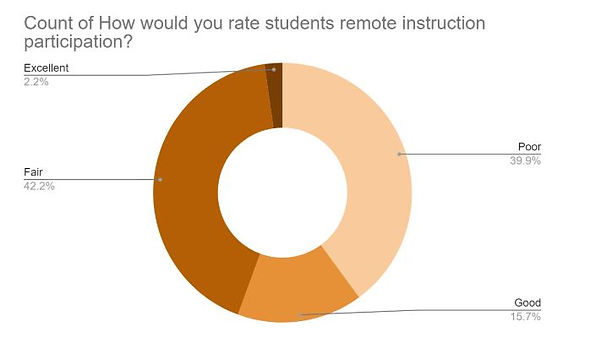
In a survey where options were ranked (from lowest to highest) poor, fair, good, and excellent, 82% of students leaned toward the lower end of this scale to rate their participation in online lectures (See Figure 2).
“This is definitely not what I signed up for.” Lauren Reavey, a second-year student says. “I definitely participate less because it feels less personal and kind of weird to participate in a Zoom lecture compared to in-person.”
Figure 2
Along with student participation being low, the survey shows that 65% of students rate communications from Rutgers administrators as “poor” or “fair” (See Figure 3).
Reavey says, “A lot of my courses are now more work than they were before … it is harder to reach them [professors].”

Figure 3
personal inequities
With such a large percentage of students unable to concentrate and unable to participate, there are a plethora of suggestions as to why that might be. Mental health, changing sleep cycles, student digital equity access, and home-life situations may play a major role here. Over a third of students rate their access to technology resources at home as poor or merely fair. On a similar note, almost 80% of students say that their work has been at least somewhat impacted by the reduced access to Rutgers libraries. And a staggering 72% rate their home situations as poor or fair in regards to being conducive to studying or participating in online classes (See Figure 4).
In an unprecedented situation such as this one, the department of Residence Life at Rutgers has been doing its best to keep students out of toxic home environments. Students can apply for extenuating circumstances, such as an inability to pay rent elsewhere, an unstable home life, or other personal reasons, according to Savarese. This allows the students to stay in the University residence halls for an extended period of time. However, this alone can be a health risk and a huge distraction from remote learning. With approximately 1,300 students still approved to stay on campus, the residence halls could be a festering breeding ground for coronavirus.
“To be honest, there have been students who have not felt well but who have called and the state said ‘we are no longer testing unless you have extreme symptoms,’ so there may be students who are asymptomatic or have mild symptoms but they are not able to get tested,” Savarese says.
But these students may have nowhere else to go. 45% of students report the pandemic affecting their living situation “a lot” or “extremely” (See Figure 5). Whether or not these are health-related, travel-related, or financial-related, it’s without a doubt that shifting locations takes a toll on mental health and ability to properly function as a University student.

Figure 4

Groups such as the Rutgers University Student Assembly (RUSA) constantly work to improve these remote learning conditions for students. On March 26th, the Assembly passed a resolution advocating for student refunds, student grading adjustments, and compensation for student workers.
The resolution reads, “The spread of coronavirus likely impacted the academic standings of many students, and this should be rightfully and appropriately taken
Figure 5
into account by prospective employers, recruiters, and graduate programs.”
RUSA also enacted the Securing Allocations to Fund Emergencies (S.A.F.E.) Act, which directly allocated $125,000 into the RUSA Recovery Fund. This works with the Dean of Students to distribute one-time financial assistance to students in need. RUSA describes this as one of the largest projects of the organization’s history and says, “Whether you're struggling to make rent, to purchase food for your family, or need some assistance after you lost your job, we can help.”
The student government’s advocacy came as petitions circulated social media, one in particular titled, “Tell President Barchi - Pay Student Workers NOW.” The list of demands included proper personal protective equipment for current student workers, and paid time off for those unable to work during the pandemic. This petition received over one thousand signatures. The University has not made any public announcements regarding the petition or its contents.
what the future holds
The lingering question is whether or not these problems for students will cease to exist.
Many students could be forced to live in non-ideal home situations, in digitally inequitable environments for much longer than anticipated.
“If you were to design a place to make sure that everyone gets the virus, it would look like a nursing home or a campus,” said Paul LeBlanc, the president of Southern New Hampshire University in an interview with The Atlantic.
This public health crisis has combined with an economic crisis to spark a debate on the efficacy of an online education. The conversation of reopening in the fall has been on the table for weeks among central Rutgers administration.
How many students would be willing to pay full-time for an online education? Only 2.5% of students rated their remote instruction participation as excellent. Rutgers courses cost $1,200 per course, usually. Will only 2.5% of students see this cost as reasonable?
Miller, who has been in communication with other administrators at Rutgers, is especially cognizant of the economic crisis faced both by University faculty and students. He regularly verbally surveys his classes during Zoom lectures -- finding out more about student hesitation to come back to campus in the fall.
As the virus seems to show little sign of disappearing any time soon in New Jersey, one of the world’s largest pandemic epicenters, more students are growing fearful of returning to campus. And this fear raises a number of follow-up uncertainties, including the status of student workers, part-time lecturers, unions, and of course, student tuition. The University has yet to make any decisions about the fall semester.
Miller says, “I think they have to find some sort of middle ground here … if nobody comes back to campus, does that mean the University lays off all its workers?”
.png)
He suggests cutting student costs and requirements, as a way to incentivize retention for the fall semester. And he is among many who have apprehensions regarding the consequences of reopening the University in the fall. Some students have cited fear of infection from a second or third wave in the fall. Other students simply do not think the education will be worth it.
“I think it would further affect my education. Having a class start-to-finish online -- I feel like I really would not get a good connection with my professor or classmates,” Reavey says.
Low-income students forced into the non-ideal home situations may not be able to participate in a digitally inequitable learning environment for longer than a few weeks. In the case in which the University extends online learning through the fall semester, they may need to provide higher financial assistance or loan out technological assistance.
Miller says, “COVID-19 is fear of the unknown … This country has a history of not looking long-term.”
Possibly, if the United States had reacted faster, if Rutgers University administration was more prepared, we would not need to worry about the fall semester. Perhaps New Jersey would not be facing approximately 140,000 cases.
By February 3rd, China, the initial epicenter of the virus, had locked down 46 million people. Over 4,000 are confirmed to be dead from the virus in China. Over a month later, Italy reacted by shutting down normal life for its residents. Still, over 26,000 died. And, by April 20th, 42 American states ordered their residents to stay at home. Over 55,000 are dead here.
Late national reactions on a central administration level have an effect -- both statewide and at hubs like Rutgers.
What has proven to be a late national reaction has also proven to be devastating for the University’s students and staff.
Steven Miller, Rutgers.edu

